
Written policies & procedures
Standards become more useful when they reflect real situations, use accessible language, and are revisited as the organization changes.
ARH Ethics & Governance · Reading excerpt
A 15-page excerpt from The Compliant Enterprise: Ethics, Fiduciary Governance & Risk Management for Business Leaders. It brings together two connected chapters: building a compliance program that functions in practice and building an organizational culture that can sustain ethical judgment.
PDF · English edition · 15 pages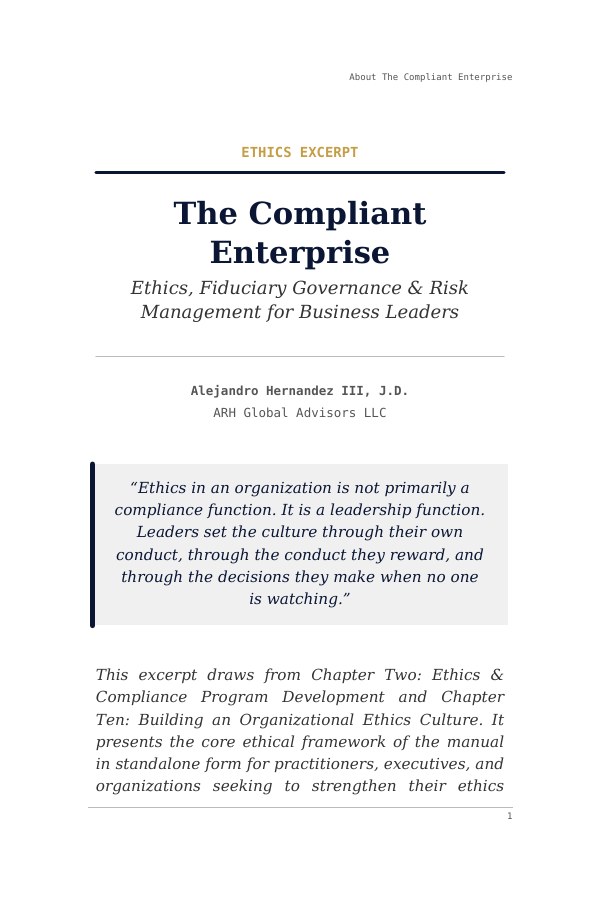
About the excerpt
The excerpt frames ethics and compliance as a working system rather than a document set: policies need owners, people need usable channels to ask questions or raise concerns, and leaders need to make a visible standard real through their own conduct.
It is designed as an educational reading resource for practitioners, executives, owners, and leadership teams. It is not a substitute for law, regulation, investigation, or fact-specific professional advice.
Drawn from Chapter Two, Ethics & Compliance Program Development, and Chapter Ten, Building an Organizational Ethics Culture.
Part one · Program development
The excerpt uses seven connected elements as a practical orientation for examining whether an ethics and compliance program is operating in daily work rather than only on paper.
Standards become more useful when they reflect real situations, use accessible language, and are revisited as the organization changes.
The function needs an accountable owner, appropriate resources, access to leadership, and a credible route for escalation.
Role-relevant learning should explain the purpose of the standard, the practical risk, and the expected response—not simply complete a requirement.
People need trusted ways to ask questions and raise concerns, with confidentiality and protection handled to the degree practicable.
Ongoing review, exception reporting, and periodic evaluation help reveal gaps before they become larger problems.
A stated standard loses credibility when accountability changes according to role, status, or convenience.
A responsible response examines what happened, addresses the root condition, and improves the program rather than merely closing a matter.
Part two · Organizational culture
The second chapter turns from the program architecture to the daily signals that make an ethical culture believable: leadership conduct, expectations people can use, safe reporting, and a commitment to learn.
Culture is shaped by what leaders do under pressure, what they reward, what they tolerate, and how they respond when a difficult truth arrives.
A code of conduct is strongest when it translates values into understandable expectations and identifies where people can turn when a situation is unclear.
A reporting channel gains meaning when people believe concerns will be heard, investigated appropriately, and met without retaliation.
Programs need honest assessment, documented learning from incidents and near-misses, and renewal as responsibilities and risks evolve.
Reading reflection
Use the excerpt to identify one standard, channel, or review routine that should become more visible in ordinary work. A practical improvement begins with an honest view of the current condition, a named owner, and a date to return to the record.
Download
Download the original English PDF to read the two selected chapters as prepared for this educational publication.
Excerpt questions
These answers describe the excerpt’s educational scope and its connection to the publication record.
No. This 15-page excerpt draws from two chapters of The Compliant Enterprise. The publication record describes the full ten-chapter manual and its broader governance themes.
The excerpt focuses on ethics and compliance program development, including seven effective-program elements, and on building an organizational ethics culture through leadership, codes of conduct, reporting, and continuous improvement.
No. The excerpt is general educational material. Readers should work with appropriately licensed and qualified professionals for fact-specific legal, regulatory, financial, tax, investment, investigative, or other professional matters.